Tag: ultralight backpacking

GearGear reviewsUncategorized

Gear review: Hilleberg Enan

A few years back my first gear review I ever did on this site was a review of the Hilleberg Akto. I liked the tent but found it had too many faults to really consider it a keeper. I even wrote in that review that if Hilleberg were to fix the sagging innertent and lighten the tent to around 800grams that I would be more than happy to purchase the upgrade. A few years later and as I so humbly like to take credit for (though they probably have no clue who I am.. still), Hilleberg did upgrade their Akto with the Enan. While not 800grams, it is 1100grams complete in stuff sack with pegs. They did fix the sagging innertent and as an extra bonus even gave it a lot more ventilation allowing for better  air circulation and much less condensation.

DSCF4387
The Hilleberg Enan has a small footprint, allowing setup in tight areas

I will start by saying that I love the Enan, I think it is an excellent tent, fun to use, fast and easy to setup that even a monkey could make it work. The enan is by far the easiest tent I have ever had the pleasure of setting up, even beating out the Mountain laurel designs Duomid in simplicity. A small tent pole and theoretically two pegs and your done. It really is that easy.

You might think that being a lighter tent, the Hilleberg Enan loses out on space, or “ruggedness” compared to the Akto. I beg to differ, this tent is made for the mountains, and all the weather than entails. I can gladly say that even in the heaviest of winds, worst of downpours and even light snow the Enan has held up really well.

DSCF4251
Two large vents on eachside of the Enan allow for great air circulation


What is it:

The Hilleberg Enan is a single man, tunnel, coffin style, double walled tent and Hillebergs lightest tent in their line-up. People like to describe these tents as bomber, but honestly I hate the term, so I will stick with rugged, mountain tent for 3 season use. Though, for many people, the Enan would work just as well as a 4 season tent.

Weight:

The Hilleberg enan 2016 variation that I have weighs 1200grams complete with all guylines, tent pegs and stuff sack. The 2016 variation uses Kerlon fabric 1000 which is a little heavier than the 2015 variation that uses Kerlon 600. Not the lightest single man tent on the market, but definitely not the heaviest either

Size:

Where the Akto lost me in a sagging innertent, weight and bad ventilation along with being a tight fit. The Enan fixes atleast most of these issues and because of no sagging innertent, the Enan even seems roomier. While I love the Enan experience, I don’t really want to be stuck in it for longer than just an overnight sleep. I find the coffin style one man tent to be just a little tight for my liking.

screen_shot_2015-05-01_at_3.59.41_pm

One tent to rule them all?

I think for most casual backpackers looking for just a single tent that they can have for 30 years in any weather conditions, the Hilleberg Enan, much like a lot of Hilleberg tents, is just that tent. It’s light enough for most backpackers, and robust enough to last a lifetime. On top of that it is extremely fast and easy to use. For taller people like myself at 6’3″ (190cm) I would suggest looking elsewhere as it may be a little to tight a fit for the long haul. If you are looking for an ultralight tent, then I would also suggest looking elsewhere as the enan is on the heavy side when compared to many competing tarp-tents. Though to be fair, most backpackers carry more than just a tarp, they usually have trekking poles (250grams minimum, inner-tent of some kind, 250 gram minimum, ground floor… so on and so forth)

However where Enan wins, and Hilleberg in general, is in quality. Your not going to find a better made tent anywhere. The attention to detail, the fabrics, the quality of the sew, there’s nothing quite like a Hilleberg, which is why I’m always willing to give Hilleberg a chance. There’s nothing quite like the look and feel of a Hilleberg and the Enan is no exception.

DSCF4328
The Hilleberg Enan really is simplistic perfection. An excellent one man tent


Conclusion:

As I stated in the beginning, I love the Hilleberg Enan. Maybe it’s the quality of the product, the ease of use, or perhaps it’s just the brand Hilleberg. Whatever it is it’s hard for me to part with this tent. If your somebody who wants a simple to setup, one solution for all conditions and don’t use trekking poles, then the Enan is hard to beat. However for me the Hilleberg Enan is a tent that is too small for my use. But it’s just so damn good.


Pros:

  • Lightweight single man tent
  • Fast and easy to setup and use
  • Excellent build quality
  • Hilleberg
  • Great ventilation = lower condensation


Cons:

  • Expensive when compare to most chinese manufactured competitors
  • Heavy for the size and living area


You can buy the Enan in Sweden at: https://backpackinglight.se/varumarken/hilleberg/

or Europe: https://backpackinglight.dk/brands/hilleberg


GearGear reviews

Gear review: Jetboil TI Sol

I have owned the Jetboil TI Sol for almost 3 years now, so this has to be the slowest gear review in the history of gear blogging. I’m not sure if I can add anything to discussion, but what the heck. The Jetboil TI Sol is the titanium version of the Jetboil solo stove. A complete cooking system in a light package. It’s main purpose is to boil water, and it’s damn good at boiling water.

If  your like me and just about any other backpacker on the planet, your main need is to boil water to rehydrate your packaged foods and boil for coffee.. then the Jetboil should suite your needs just fine.

What you get

The Jetboil TI Sol is a self contained unit with everything thats needed in a simple little package. It has a pezo lighter built in, an adjustable pressure regulator, insulated pot sleeve, Plastic lid with strainer, a plastic cup and last but not least the actual pot itself that is .8 liters.

DSCF4435

A gas canister easily fits in the pot along with with the regulator. I usually leave everything at home except for the pot, lid and gas regulator. Though I’m certain that the rest of equipment serves a purpose….

DSCF4429


In use

I am a sucker for simplicity and I’m not sure it’s possible to make an more simplistic stove. Just screw on the gas can, put the pot on and press the ignitor. (this of course can be said for any jetboil or these style of stoves). Having used this stove on and off for over three years it has only failed me once, in Iceland, pouring rain the ignitor didn’t take. With that one exception this stove has been very trustworthy. There is a lot to be said about these kinds of stoves and there is a very good reason they have become so popular during the last decade or so.

With that said the Jetboil TI Sol has one function and one function only: Boil water as quickly and effeciently as possible. There is no simmer (officially there is, but don’t bother). This one function it has and serves perfectly. Boil time on my kitchen stove (which by the way is the most useless metric in backpacking is a staggering 3 minutes and 47 seconds with .5 liters of water) Fuel consumption is around 5grams of fuel. In the wild depending on the wind and chill factor (colder air means slower boil time), boiling is around 3.5 – 5 minutes. I usually try to calculate for my trips 8 grams of fuel per boil.

However this gives kind of an unrealistic picture of the jetboil and how I use it. I rarely boil water in the wild and most the time I run water through my filter and get the water to “warm enough” – which is around 2.5 minutes and 4 grams of fuel. Meaning one tiny can at 229 grams will last me a very long time along a trail.

DSCF9303

Eating

This probably goes without saying but I will write anyway. I eat directly from the pot, because the pot is rather tall I find that regular length spoons are a pain, so I use a long length spoon to dig deep in the pot. Also, though the cozy I’m sure serves a purpose, it atleast let’s holding a freshly heated meal possible.


Conclusion

A lot of new stove system have been introduced on the market since the Jetboil TI SOl has been released. The weight differences today are perhaps not as wide as they once were. Aluminum systems that weigh 100 grams more can be bought for a 100usd less. There are also simple pot and stove solutions that weigh 150 grams total (evernew pot and BSR 1000 titanium stove). However, I still find the Jetboil ti sol to be a viable solution if your looking for this style stove. They can now be purchased at competitive prices on ebay and amazon. This system is still to my knowledge the lightest fast boil system available (correct me if I’m wrong)

After three years this system is still going strong for me and while it might not be my first choice, it is by far my simplist choice.


The good:

Complete cooking system

Fast boil

Self contained unit that fits nicely in my backpack

Relatively light at 242 grams for the trimmed down system that I bring (just the pot, lid and regulator)


The bad:

Like hot water? That’s all your going to get with this. Don’t bother bringing anything else

Not sure what purpose the pot cozy has.

Heavy compared to some of the ultralight kits available. (Trail designs, BSR1000, any alcohol stove and so on)

Uses gas – I am terrible at determining how much gas I need to have with me, thus I always bring way too much.

No wind shield.. Always looking for a hole to dig this down in as each breeze increases boil time significantly.

GearGear listGoing LighterUncategorized

Starting your backpacking life

I have a friend who is starting to get interested in backpacking, we went on a short trip last year and had a great time despite the fact that we melted each-others shoes and almost burned down our hut. Anyway, to say his backpacking skills were limited is an understatement, and his gear was pretty bad as well. All things considered it wasn’t really his thing. But the experience kept with him and he’s starting to book different trips for backpacking and so on. With that he also wants suggestions on gear – this is when I realize that I’m better at writing generalizations than actual gear suggestions based on user experience.

So I’m having to really think about this a bit as I want him to have good gear that will last a while, be easy to use, comfortable and light. I want him to avoid the regular failings of every newcomer to the backpacking experience. The one that starts with the visit to the local gear shop, asking the salespeople what gear to buy and leaving with no money and a shit load of useless gear that will be phased out with experience.

To start I have to look at my local market: What is possible for him to buy in our area. Being we are in Sweden it’s not the easiest to buy “ultralight gear” without it costing and arm and leg (with import fees and shipping). Also, one of the pleasures of shopping is seeing, feeling and experiencing. So in this sense the local gear shop is an excellent place to start for a newbie. It’s not just a question of staring at a picture and making a purchasing choice.

I wrote in an earlier article that I didn’t think that “Ultralight” might be the best choice for every backpacker, and I still hold that to be true. I think staying true to the ultralight idea requires a steady knowledge of a specific climate. (why ultralight tends to work very well along major trails like the Appalachian and PCT but much less so in brooks range alaska and Northern Sweden, where temperatures and weather can be highly unpredictable). With that said I do think that striving after minimal weight should be the focus for just about anybody. Why buy a backpack that holds 70 liters and weighs 3 kilos when you can purchase a backpack that can hold 70 liters and weighs just 900grams. The former is just a stupid choice regardless of where one might hike.

The same can be said for a tent, sleeping bag and sleeping matt as well. Ultralight in the regard of sleeping under a cuben tarp and no ground floor is perfectly acceptable in warmer more predictable climates and trails. 300 grams and your done. Or you can choose a two man Hilleberg beast that weighs 3kilos. While the Hilleberg might be perfect for two people during a winter trip, it serves no real purpose in the summer months. However something like a Mountain laurel designs Trailstar with an inner tent might be the best of all worlds. Total weighing under 1 kilo, large enough for two people and can withstand just about any weather that is thrown it’s way.

DSCF4248-2
The Hilleberg enan is a fun, fast tent big enough for most users. Expensive but will definately hold for the long run.


dsc07830
The MLD duomid is a large tent that weighs around 600 grams. With an innertent duomid becomes the ultimate 1kilo dubble wall tent.

This kind of reasoning should be applied to gear purchases. I know it’s an awesome experience walking into  a gear shop and buying all the coolest gadgets, and perhaps you should buy them so that you can get a better understanding of what you actually need. But, if your more like my friend, who will probably make the initial investments but never keep the same kind of interest that I have, than buying the right gear from the very beginning will help you and (him) keep the interest longer by making those first crucial hikes an enjoyable experience.

In this exercise I will put up several gear solutions in table form and total weight. One is the traditional solution, the middle column is for “lightweight in gear shops” solution and the third is the optimal lightweight solution for any newbie that won’t cost significant sums of money. You can start splurging on cuben fibre gear once the interest has become big enough to justify that kind of investment.


Gear choices:
Traditional weight grams lbs. Lightweight gearshop weight kilo lbs. Cheap(ish) preffered lightweight weight grams lbs.
Backpack Backpack Backpack
Fjällräven Kajka 75liter 3.6 7.92 Granite gear V.C 0.98 2.156 HMG Sidewinder 4400 70liter 0.980 2.156
tent tent tent
Hilleberg Nallo 3 6.6 Hileberg Enan 1.2 2.64 MLD Trailstar + inner 0.98 2.156
sleeping bag sleeping bag sleeping bag
Fjällräven Sarek 3 season 1.3 2.86 Mountain hardware hyperlamina spark 0.65 1.43 Mountain hardware hyperlamina spark 0.65 1.43
Sleeping mat Sleeping mat Sleeping mat
Exped down 9 1.2 2.64 Thermarest xlite regular 0.38 0.836 Small Thermarest xLite 0.23 0.506
Total big three: 9.1 20.02 3.21 7.062 2.840 6.248


It is possible to get a lighter tent and even cheaper tent than the Hilleberg Enan in a gear shop. I just put in the Enan because out of gearshop tents available the Enan is my preferred tent. Expensive but great. However the Mountain laurel designs Duomid or Trailstar with an inner-tent is atleast in my own reasoning the best all around solution for comfort, weight and durability. This I have as my choices in the “prefered gear list” column. The difference between gearshop and prefered is the fact that prefered will probably have to be special ordered directly from the producers websites while the gearhop is usually gear easily found in most gearshops.

Also, there are certainly lighter and warmer sleeping bags than the Hyperlamina spark, but for a good three-season lightweight sleeping bag that is cheap, the hyperlamina is hard to beat.

All these gear choices are chosen for the solo adventurer in three season hiking in all-around temeratures and climates. Meaning that this solution will work just as well on the pacific coast trail as it would in northern sweden.

A good rule of thumb when purchasing gear for the first time is the 3 for 3 concept. The three biggest pieces of gear: tent, sleep system and backpack for a total under 3 kilos. The lightweight gear shop solution crosses the threshold by 200 grams, but I think that’s ok all things considered.


Gear reviewsRunning

Gear Review: Merrell all out terra trail shoes

After my Iceland trip last year I realized it was time to buy new shoes as I had started using tape to keep my Haglöfs together. I’m not a big buyer of shoes so I had no idea what was being made at the time. I did however have a plan in my head of designing my own pair of hiking shoes. My ideal pair that I would design would be as light as the Haglöfs LIM low but offer superior grip, would have better toe and heel protection and if possible would even have a built in gaiter to keep rocks out. This to me would be the perfect trail hiking shoe.

So in my new found inspiration in life, and absolutely certain I had invented in my head the next great shoe; I decided to make my way to the local gear shop here in Stockholm and get more inspiration for how my new shoes might look. Little did I know how far shoe development had come in the time since I last bought a new pair of trail shoes. While a lot of the shoes I was looking at was close to what I had in my head none of them checked all the boxes… Until I ran across a pair of Merrell All out terra trail shoes. They had the same lightness (almost) as my beloved Haglöfs, they had much better grip with the vibram sole, toe and heel protection and as an added bonus they even had a built in gaiter.

It didn’t take me long to do the math in my head: Either buy these shoes for 100usd or invest thousands of dollars, design a pair, spend countless hours making different prototypes and in the end make simply a competing shoe that probably wouldn’t be as good as these shoes. So I purchased the shoes and a year later I’m not disappointed. For one my toes aren’t black and bruised anymore from stomping on rocks, I’m not sliding down the side of a cliff because of bad grip and I no longer have to bring gaiters with me.

Features:

DSCF3807

These shoes have excellent grip for most surfaces besides ice. I have done trail runs, backpacking and regular road races in these shoes and I am not at all concerned about the grip. You can’t go wrong with Vibram soles and the Merrell all out terra trail shoes make the best of it.

DSCF3806

Mesh all around no goretex to be seen anywhere means these babies get wet fast and dry just as fast. Perfect! Even the tongue and insides are mesh. This shoe is perfect for the trail.

DSCF3805

No more black and bruised toes. This nice solid rubber toe guard protects my toes from any rocks or branches the trail happens to throw at me. I still stumble on my ass, but atleast I’m not sitting for 10 minutes holding my toes.

DSCF3801

The Merrell allout terra trail shoes have excellent heel protect, side protection and a built in gaiter. Whats not to like about these near perfect trail shoes?

DSCF3798

The Merrell allout terra trail shoe fits like a glove around the feet. I am truly impressed by these shoes and even after about 500 kilometers they are still holding strong.

Weight:

The allout terra trail shoes are light, not as light as some trail shoes on the market, but I will take the extra weight for the total protection and gaiters anyday. These shoes weigh in at 333 grams each or 666 for both.

DSCF3815

Comfort:

The Merrell allout terra trail shoes fit my foot very well. I love the gaiter wrap and the missing tongue. These shoes just sit tight regardless of the terrain. The only real negative here is that I usually need a pair of Superfeet in my shoes, on the Allout terra trail shoes a pair of superfeet make the shoes lose their form a little. Or perhaps I need to buy a smaller pair. Not really sure, but they don’t pass inside the shoe as well as on some other shoes. But that’s not the worst thing in the world to deal with as the shoes are comfortable without superfeet insoles.

Conclusion:

As I stated in the introduction of this review, I had gone into the shop looking for ideas to the shoes I had already designed in my head. I was thinking of either starting my own company with my own shoe design or going Haglöfs with the design idea and see if they would license it. I left the shoe store with pair of Allout terra shoes and never looked backed. These are exactly the shoes I had in my head. Truly worth the investment. I see no reason not to buy these shoes if your looking for an excellent pair of outdoor trail shoes. I can’t really judge them as trail running shoes as I have only run a few runs in them totaling about 100kilometers. However I do have closer to 600kilometers walking in them.

backpackingblogGearGear listultralight backpacking

Snowy arctic paradise and gear failure hell

I felt the warmth on my face as the afternoon sun crept through the mountain ridges, my body hot from from the layers of winter clothing and the gore-tex jacket and pants keeping all the moisture in. My winter backpack weighing in at 11 kilos and well prepared for anything the cold winter night could throw my way. I had been longing for this moment for over 4 months, planning, preparing and daydreaming about this very scene, the skis under my feet, backpack on my back and the magnificent mountainous regions stretching as far as my eyes could see.

IMG_3835
I had planned everything in the minutest of details, nothing left to chance, this far out in the Swedish wilds in the middle of winter is nothing to take lightly. -20 degrees and fridged wind blowing through the valley, even the slightest mistake could lead to serious problems.

IMG_3836

IMG_3833

My skis, a pair of Madshus Glittertind backcountry skis are made for this kind of backcountry touring, my poles and my trusty ski boots all fitted and working in unison, propelling me across the harsh arctic landscape. A smile is stuck on my face, and sheer joy has taken over my consciousness. Then, from out of nowhere I hear a snap, suddenly my ski is off to the side of me, I lose my balance and fall, somewhat reluctantly, headfirst into a deep snow drift. Smile gone, joy replaced with pain, the pain of freezing wind blowing down onto my wet, cold face. ”Shit” I said, as I looked down, realizing the sole on my ski boot had separated from the boot itself.

IMG_8249

Sitting there, hands frozen, ears and toes starting to go numb, and tears dripping from my eyes because of the cold harsh wind, I knew I had a problem. 10 kilometers away from the nearest cottage, and now no skis to ride on. As I looked up, not too far away I spotted a small emergency wind shelter, strategically placed for just these kinds of incidents. I picked myself up and made my way to the shelter. I took off my ski boot and assessed the damage – the sole had almost completely come off from the rest of my boot. Not sure how to fix it, I did the only thing I could do, I wiped my boot clean, pulled out my duck tape and got to work.

IMG_7484.JPG

The patch job might not have been the best, but for fucks sake, it’s duck tape and I’m desperate. As the saying goes ”if you can’t fix it with duck tape, your not using enough”. After fixing my ski boot I had a decision to make: Stay here at the wind shelter for the night, or jump on my skis and hope I can make it back to my starting point and to safety before night fall. I sat in the shelter for a while longer, freezing, I decided it would be best to jump on my skis and make a go for it.

I learned some very important lessons this day: 1. Duck tape doesn’t hold in freezing cold and 2. If one boot breaks, there is a high possibility the other will follow suit.

After less than two kilometers into my 10 kilometer journey both the silver tape and my only working boot broke. 8 kilometers back to safety, night fall in an hour and I was starting to prefer the warmth of a house and bed to my current predicament.

Now balancing on two cross country skis I made my way painstakingly slow and wet (I fell, a lot). I couldn’t help but see myself in an episode of some Bear Grylls survival show, fantasizing about how I might have to eat tree bark and drink my own piss to survive. Or perhaps I would be like one of those Vietnam blokes that during the war sought refuge in the jungles only to come out 40 years later to a whole new world. Yes, these are the fantasies that kept my mind occupied during this cold journey back to safety. Finally, after deep in fantasy about how king Gustav Vasa must have felt this way when he skied 90 kilometers on one ski in the 1600s to get away from an invading army, finally, I crossed the marker I had been waiting for, and not too soon either. The 2 kilometer marker.

Now both my soles have come completely off, there was simply no possibility for me to even balance on my skis anymore. So I took my skis off, strapped them on my HMG sidewinder, took my ski boots off and hiked the remaining distance in knee high snow. It was cold, but exhilarating, my adrenaline pumping hard kept my feet and body warm.

IMG_9900
This is the story of my 4 day trip in the frozen backcountry of Jämtland in northern Sweden. The 4 day trip that ended up being just one day because of one fateful decision I made the week prior: Namely, the choice not to buy new ski boots when I knew the ones I had were starting to get worse of the wear. I knew I probably should have, I knew it in advance, I had even looked at a few but opted to wait until next season, thinking I could get one more out of the boots I had. To say this story could have ended much much worse is an understatement. No cell communications, no GPS phone with me, and the particular route I chose was the complete opposite of the one I had left with my wife – for really spontaneous reasons.

With that said, I had a great time, I learned a lot and I can laugh about it now. So heres my suggestion – when it comes to winter camping, don’t be stupid.

My gear for the trip:

Item Ounces Grams
Packing
Thermarest Pillow Sheet 1.9 54
Black Pillow Case Holder 1.5 43
Red 2l Pack Bag 0.7 21
Hmg Sidewinder 4400 34.2 970
Shelter
Msr Winter Stake 0.8 22
Hilleberg Enan 38.8 1100
Sleep
Montbell Ul Pillow 2.6 73
Enlightened Equipment Quilt 22.9 650
Pee Bottle 0.5 15
Xtherm 20.5 580
Ee 30 Syntheic 28.1 798
Cooking
Sea To Summit Long Spoon Ti 0.4 12
Zefa Water Bottle 3.5 98
Marches 0.4 11
Feet Warmer Water Bottle 0.4 10
Evernew Flatpot W Lid 4.8 136
Clothing
Western Mountaineering Booties 4 114
Wp 200g Pants 6.1 174
Haglofs Green Wind Jacket 2.3 65
Kristal Ul Gator 3.2 92
As Tucas Red Beanie 1.8 52
Montbell Puffy Pants 16.8 475
Haglofs Black Layer 2 Sweater 14.3 405
Wp Thick Socks 2.9 81
Hestra Mittens 8 226
Wm Flight Jacket Xl 13 368
Haglifs Lim Puffy Jacket 6.7 191
Other
Murla Knife 0.7 20
Candle Lantern 6 170
Ul Teeth Care 3.1 89
Bd Headlamp 3.6 101
Iphone 6s Plus Ink Case 9.9 282
Msr Towel 1.2 35
First Aid Kit 3.1 89
Usb Cables 0.8 24
Snowclaw 5.9 168
Fuji X-t1 Body 16.1 456
Fuji Samyang 12mm 10.4 294
Fuji 18-55 11 311
Fuji Battery 1.6 46
Fuji Battery 1.6 46
13000 Battery Pack 12.3 348
Worn
Black Beenie 1.2 35
Aklima Hoody Wool 13.3 377
Black Shell Pants 25.3 717
Salomon Goretex Orange Shell 870 31 879
Puma Winter Running Tights 9.4 267
Fleece Mittens Bula 2.5 70
As Lucas Ul Pants 2.3 64
Consumables
Butane Cannister Small 7.1 202
Food For A Day 26.5 750
Toilet Papper 5.3 150
Total 423.1 11993
backpackingessentialsGearGoing Lighterultralight

The UL Jacket – Essential gear for any backpacker

I once wrote an article a long time ago about the ultralight wind jacket and how I felt it was the single most important piece of gear for any backpacking regardless of your weight preferences. (Whether you enjoy ultralight or prefer being heavy and miserable.. ) I would like to propose that the second piece of essential gear for any backpacker would be an ultralight down jacket (synthetic works as well but usually heavier for the same warmth). For the last 3 years I have been using a lightweight down jacket that weighs at around 180grams for the XL size. (Haglöfs L.I.M essens down). I find this jacket much like the wind jacket allows me to leave a few extra layers at home. And the down jacket combined with a wind jacket is hard to beat in weight to warmth ratio.

unnamed

When I talk about ul down jacket I mean any down jacket under 200grams for a large size.

My typical three season layer scheme looks something like this:

Wool or bamboo fiber Shirt 150grams – main layer always on

Windjacket with hood 80grams – Always with me and depending on weather usually always on (in the nordic regions of the world)

Down jacket 188grams – I usually put my down jacket on the minute I stop for the day. It’s very rare that I actually need this while hiking.

Total weight: 418grams or about 1 lbs.

That’s it. That’s my entire upper layering system for most three season hikes. If it’s raining I put my rain jacket on (so fourth layer). And depending on how long I am gone I usually don’t bother with a an extra shirt to sleep in, unless I will be hiking in wet and cold regions. Also, as you can see, I don’t bother with sweaters or thicker shirts or anything else that usually becomes redundant and heavy when you have a light down or synthetic jacket. Most sweaters, wool or otherwise, are going to be heavier than a down jacket and won’t be anywhere near as warm.

This setup will easily keep me warm to down around 30 degrees farenheit. So even on cold nights when the temperature will drop to 20 degrees, I can keep warm and snug at night in my three season gear (quilt, sleeping pad and down jacket).

As with any high quality UL product, lighter usually means more expensive, but there are always exceptions to this rule. However no-matter what, your never going to get into silly money prices that you could end up paying for when purchasing main stream products that weigh much more. If you inclined to do so, there are a few MYOG patterns and kits for synthetic and even down UL jackets. When my current jacket breaks down I will probably replace it with a synthetic jacket. Main reason being that I use this same setup even in the winter with the inclusion of a thick down puffy, which creates more moisture, and that breaks down my inner down. So, a synthetic would fix this problem.

Ultralight Down and Synthetic jackets:
Haglöfs L.I.M Essens down
Western Mountaineering Flash jacket
Yeti streto ultralight down
Crux turbo top
Mountain Hardware ghost whisperer
Mountain hardware Micro Thermostatic (synthetic)
OMM Rotor smock (synthetic)

These are just a few of the ul jackets currently available as of this writing.

If your interested in sewing your own:

The kinsman insulated pullover is the best design I’ve found

http://thru-hiker.com/kits/kinsman_kit.php

backpackingblogDestinationsLandscape photographylaugavegur

Trip report: The Laugavegur trail day 4

Emstrur (Botnar) to Þórsmörk

— 15 km, estimated walking time 6-7 hrs, 300m net descent —

dsc07873

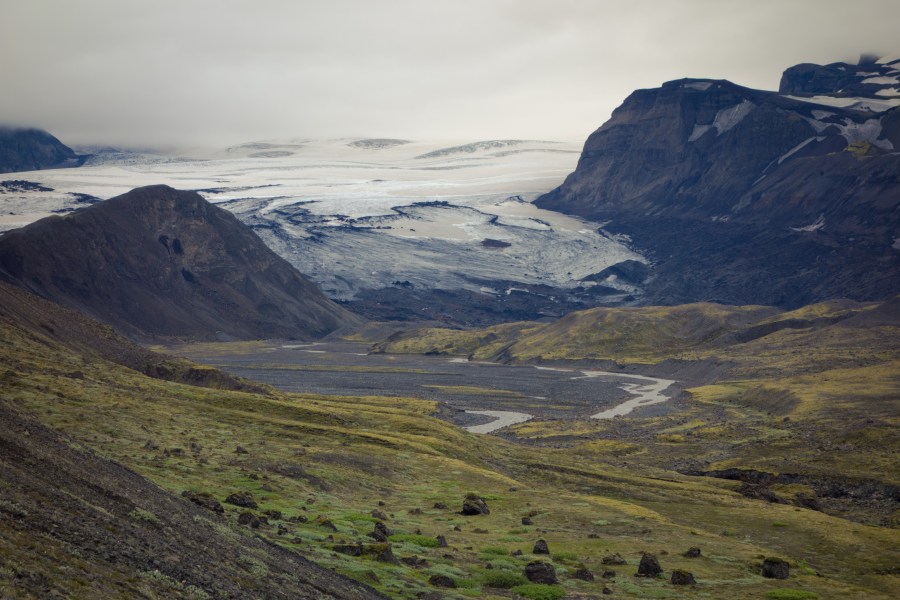
Again, I was left breathless by the amazing hike. Glaciers, desert, rivers, mountains and forest all within a 15 kilometer hike. This day starts off in the canyon of Syðri – Emstruá. Here there is a steep path that leads a bridge that runs over the glacier river.

dsc07895

There is something epic about a raging river being fed with a glacier.. simply amazing. I sat here for sometime and ate my breakfast and just enjoyed the incredible view, engrossing my soul completely in the moment.

dsc07894

I learned along this trail that it was time to replace my beloved Haglöfs LIM trail shoes. I decided from this moment on that I would wear trail shoes that had toe protection and better grip. On top of that I realized that I’m not really into video production.. I shot hours and hours of video along this trail and so far haven’t edited anything.. I prefer working with photography.

dsc07910-pano

After this long trek along the sandy, volcanic ash desert everything changes to a kind of mini forest.

dsc07932

dsc07949

This little house just seemed lost in the wilderness – It was the first house I’d seen for days.

dsc07951

The house from a little further out.

dsc07967

dsc07986

After a long walk came this amazing water crossing along the Þröngá river. As always the water is freezing cold, but barely knee high throughout so wading is no problem.

dsc07992
The little village at the bottom of the valley is Porsmork, while I will be staying in Bazar, I wanted to make the little 8 kilometer detour to Porsmork to drink beer and eat peanuts. It was worth the walk. You can even take the bus back to Reykjavik from Porsmork.


From Porsmork I made my way on to Bazar where I would be sleeping for the night.

dsc08015

While this was not Bazar, it was nice nonetheless.. Not really sure what this place was called, but it was nessled between Porsmork and Bazar.

dsc08023

After a quick walk over this glacier river, I soon arrived in Bazar where I would throw up my tent and make camp for the night

Once my tent was setup I made my way to the river, laid down and chilled out for a few hours before heading off to bed. Once again, the Laugavegur trail delivered on it’s incredible views and serene enviroment.

dsc08062

Trail report: the Laugavegur trail day 1
Trail report: the Laugavegur trail day 2
Trail report: the Laugavegur trail day 3
Trail report: the Laugavegur trail day 4
Trail report: the Laugavegur trail day 5

blogDestinationsLandscape photographylaugavegurultralight backpacking

Trip report: The Laugavegur trail day 3

Alftavatn to Emstrur (Botnar)

15 km, estimated walking time 6-7 hrs, 40 m net descent

I was in no rush to leave Alftavatn, the views were simply incredible and it was nice to just hang out for a while. I knew that walking through this valley would be an amazing adventure, and with that, I laced up my trail runners and made my way towards Emstrur.

dsc07717

From the very start on the way to Emstrur, this incredible view is what I was met with. The hike from Alftavatn to Emstrur is by far the most picturesque of all the sections. From this kinds of green rolling landscapes, into long deserts of volcanic ash and a massive glacier looming in the distance like a constant reminder of the true wild that you are in.
This hike felt long, maybe it was the deep ash or the several large river crossings.. who knows, the hike is easy, but feels much longer than the 15km that it actually is.

dsc07722

The first real water crossing is about 3-4 kilometers from Alftavatn. Here I passed a whole group of heavy-miserables while they stopped to take of their boots and socks 🙂 I just trugded through, admittedly the water was cold but I warmed up quickly.

dsc07736

Here the trail takes us over the low ridge Brattháls into Hvanngil. If your looking to book a room in advance in Alftavatn and it’s fully booked (not unlikely). Check out Hvanngil, as it’s not always a known campground.

dsc07752

The first real river crossing is made on this part of the trail. It’s wide and irratic, you will have to walk around a while along the river Blafjallakvisl until you find a very wide part, and there crossing shouldn’t be a problem. You will notice however I stopped on a little sandbank in the river. I didn’t actually stop here to take a pic, to be honest I stopped here because my feet felt frozen solid from the ice cold water..

dsc07777

To say that the views along this part of the trail are amazing is an understatement. While I always find nature to be awe-inspiring, this particular part of the trail was something altogether different. I had the feeling of walking along the art gallery of god – his best pieces of art all laid out along a 15 mile trek. I took my time here, stopped often and forgot about everything else in the world, nothing mattered, I was lost in the moment and it was one of the greatest moments of my life.

dsc07787

dsc07788

dsc07798

After a while we come along the river Nyrðri Emstruá, which thankfully is bridged.. From here it’s only a few kilometers left before reaching the campground at Botnar.

dsc07773


DSC07809

After an incredible walk we come in towards Botnar which resides in the Markarfljótsgljúfur canyon with the glacier in the background.

dsc07818

The campground in Botnar is well protected from the heavy winds blowing down from the glacier. The views are incredible here and there is even a little shop here if you need some resuplies. 3G works perfectly fine along all the campgrounds throughout the Laugavegur trail – so calling home wont be a problem.


Trip report: laugavegur trail day 1
Trip report: laugavegur trail day 2
Trip report: laugavegur trail day 3
Trip report: laugavegur trail day 4
Trip report: laugavegur trail day 5

DestinationsLandscape photographylaugavegurPhotographyTrip report

Trip report: The Laugavegur trail day 2

When volcanic desert transforms into a true paradise on earth

Hrafntinnusker to Álftavatn – 12 kilometer from volcano to paradise

DSC07449.jpg

After a day and a half of hiking in rain and cold, finally some sunshine and water. I stopped here and filled up my water bottle, ate an energy bar and called home. This really lifted my spirits.

After what felt like an eternity of walking in rain and snow, after volcanic ash, rock and gravel. A long sleepless night in an unprotected snowy volcanic wasteland.

dsc07467

The Laugavegagur trail transformed itself into a true paradise on earth when I came up over the ridge and looked out upon Alftavatn.

dsc07478-pano

Alftavatn is where most pictures you see of the trail come from, and in the next section you will see why. However to get there you have to walk along a desert wasteland for almost the entirety of the 12 kilometers from Hraftinnusker.

dsc07497
My journey to Alftavatn started after a cold night of “sleep”. On top of that I of course only use trail running shoes. While this is normally never a problem, on this one occasion my feet where frozen until I got my temperature up as the first 5 kilometers of the trail was covered in mushy snow.

dsc07528
It took me about 6 hours to get to Alftavatn from Hraftinnusker, lets just say I was in no hurry at all. While it was cold, wet and at times just all around shitty, I actually enjoyed this part of the trail immensely; granted, more now when I’m sitting at home writing this book.

dsc07601

While the campground looked lovely, I opted for the cabin.. there was actually an available bed! The room here will cost about $50.00.. to me it was worth it that night.

dsc07543

Trip report: The Laugavegur trail day 1
Trip report: The Laugavegur trail day 2
Trip report: The Laugavegur trail day 3
Trip report: The Laugavegur trail day 4
Trip report: The Laugavegur trail day 5

backpackingplanningsarektrip planningultralight backpacking

Planning for a walk across Sarek

It’s time for me to start committing to this years (2017!?!) trips.. While I have a couple of smaller 4-5 day trips coming up, winter adventure and a week in the USA. The big trip coming up for me this year is a trek across, perhaps zig zagging through Sarek here in northern Sweden above the arctic circle. Often called Europes last wilderness area… Don’t know if that is true but in any case I really love hiking these northern regions of Sweden.

I like to buy my tickets early to wherever I plan on hiking. In this case I plan on buying my tickets during the week. By doing this I am mentally committing to a trip. Most the time if somebody wants to join along, its no problem to buy tickets for them later on. It also gives me something to look forward to.


DSC07830

When

I am looking at making this trek towards the end of July and through the beginning of August. I will be leaving Stockholm on the 27th of July and ending around the 7th or 8th of august. I am choosing these dates more for logistical reasons than anything else – I have a wedding to attend in Umeå (northern Sweden) on August 12th and I suspect my wife would prefer I joined her for that wedding. Coming late July also has the added benefit of being a littler drier… hopefully. This area is known for being wet, cold and it’s not usual to be snowing even in August.

Getting there:

I will be starting by Stora Sjöfallet – the northern section of Sarek national park. I was originally planning on starting in Ritsem but decided to save that for another trip. So my planning is a little ”spartan” at the moment as the official timetable isn’t released yet. But it’s all good, I’m fairly confident in my knowledge of Sweden and getting around. I will be flying into Gällivare with Nextjet.se from Stockholm and arrive at around 11.45. The bus line 93 to Stora Sjöfallet goes once a day at 8.55 in the morning. That means a night in Gällivare which gives me time to walk into town and buy Gas or Alcohol for my stove depending on which I bring. No matter if I decide to change my start to Ritsem or not, it’s the same plans and bus so I can still buy my plane ticket to Gällivare and book my hotel for the night.

How far:

I am looking at being away 9-13 days, I want to keep flexibility as an option as I don’t really feel like walking 40 kilometers a day. This trip I plan to keep my mileage rather small, somewhere between 10-20 a day as I want to make time to zig zag, climb mountains, take photos and cook nice meals. A slow, lovely walk through Europes last wild land. Total I am looking at moving about 100 -130 kilometers during this trip. It really depends on where I decide to start.

Where to start:

I want to walk north to south. No real reason for this, but I guess it’s a psychological thing. In either case I will start in either Stora sjöfallet or Ritsem. The bus line is the same 93 from Gällivare. I either hop of the bus at Stora sjöfallet at 11.00 or at Ritsem 13.05. It’s really a case of how long I want to sit on a bus and what I want to see. The important part is making all the preparations around.

Bus line 93 from Gällivare timetable http://www.ltnbd.se/tidtabeller/31/0/

The Trek:

While still unclear exactly where I want to start, I do know where I want to finish. Kvikkjokk in the southern part of Sarek national park. I also know that the bus from Kvikkjokk leaves once a day at 9.00 in the morning. But perhaps this will change as we start getting closer.

In any case my preliminary trek looks something like this starting in Stora sjöfallet (on the right) or Ritsem on the left.

Here with a start in Store sjöfallet

And ending in Kvikkjokk

This particular trek is about 110 kilometers. If I start in Ritsem and cross over my trek will be about 130 kilometers. While this could easily be done in just a few days, I really have no rush here.

Getting home

To be honest I don’t stress too much about getting home. With my trek ending in Kvikkjokk I know there is one bus that leaves everyday at 9.00 in the morning from the kvikkjokk church. Though this could change and maybe there will be another bus later in the day during the high season.

The actual timetable http://www.ltnbd.se/timetables/61/0/ – bus line 47 to Jokkmokk or 94 to Murjek train station and from there I will be taking the train to Umeå.

5.20 for bus 47 to Jokkmokk or 9.00 to Murjek…

Gear and supplies

10 days of food and gas/alcohol. I like to eat three times a day and have snacks in between. I don’t mind cold breakfast but I will still boil water for coffee. My food usually averages 650-750 grams a day for everything. One small gas canister should be adequate, but I will bring two as I plan on doing some proper meal cooking for a book project I’m working on.

Full preliminary gear list:

Item Ounces Grams
Packing
Hmg Sidewinder 4400 34.2 970
Red 2l Pack Bag 0.7 21
Red 4l Pack Bag 0.9 25
Green Pack Sack 4l 1.1 30
Shelter
Hilleberg Enan 38  1100
Ti Tent Pegs 3.5 98
Sleep
Thermarest Pump 2.6 73
Montbell Ul Pillow 2.6 73
Enlightened Equipment Quilt 22.9 650
Xlite Thermarest 15.6 443
Cooking
Sea To Summit Long Spoon Ti 0.4 12
Sawyer Water Filter W/ Bag 3.4 96
Jetboil Ti Sol 8.6 245
Clothing
Mld Waterproof Gloves 1.6 46
Haglofs Green Wind Jacket 2.3 65
Headnet 0.9 26
As Tucas Red Beanie 1.8 52
Grey Patagontia Shirt 4.8 137
Haglifs Lim Puffy Jacket 6.7 191
Wp 200g Pants 6.1 174
Ula Silnylon Rain Skirt 3.1 87
Patagonia Alpine Rain Shell 6.4 181
Other
Murla Knife 0.7 20
Ul Teeth Care 3.1 89
Iphone 6s Plus Ink Case 9.9 282
13000 Battery Pack 12.3 348
First Aid Kit 3.1 89
Usb Cables 0.8 24
Ul Tripod 3.1 88
Thermarest Repair Kit 0.5 14
Msr Towel 1.2 35
Delorme Inreach (rent) 7.1 200
Fuji X-t1 Body 16.1 456
Fuji 18-55 11 311
Fuji Samyang 12mm 10.4 294
Fuji Battery 1.6 46
Fuji Battery 1.6 46
Fuji Battery 1.6 46
Worn
Aklima Hoody Wool 13.3 377
As Lucas Ul Pants 2.3 64
Haglofs Grey Zip Hiking Pants 10.8 307
Bd Distance Carbon Sticks Pair 12.8 363
Merrell Allout Terra Trail Shoes Pair 23.5 665
Suunto Ambit 2.8 78
Fleece Mittens Bula 2.5 70
Consumables
Food For A Day 26.5 750
Toilet Papper 5.3 150
Coffee 3.5 100
Food For A Day 26.5 750
Butane Cannister Small 7.1 202
Total ex consumables 253.1 7183
Total 514.6 14587

As you can see it’s a bit heavier than my normal trips. There are different reasons for this – one is a heavier camera. Two, a heavier backpack as I plan to use the HMG Sidewinder 4400 and a lot more food. Also a different tent. But in all honesty, the weight difference on the whole is minimal.

An example of this is my MLD Duomid. If we look past the size and comfort ratio we can compare the actual weight gained and or saved

MLD Duomid with stuff sack 753grams
Tyveks Groundsheet 130grams

No innertent. Total weight savings comes out to about 200 grams if I bring my Duomid instead of Enan.

Where I lose the most weight in on my backpack, going with full rain gear instead of just a poncho/groundsheet and bringing my full camera gear instead of the sony RX100. I could of course change my mind on any of these choices by the time I take off…

15894562_1636878956606718_2471117077046148580_n

Want to join me?

Drop me a line – you see the plans, times and dates here and if your coming from outside of Sweden I can help with a bit of the planning as well. I always love backpacking with like minded adventurers. I will be carrying a little heavier gear as I am working on a few book projects, so I won’t be crushing 40 kilometers a day and instead around 15-20 with a few day treks to mountain tops to take photographs.