All posts by Kenneth Shaw

Blogger, photographer and backpacker. If you like my writing or my site don't be afraid to follow me, like or share my posts here on the site. Thanks and enjoy!

campingkidsultralight backpackingultralight kids

Gear suggestions for kids

I’m not a really big fan of owning a lot of gear. For the most part I try to keep my backpacking life simplistic for many reasons, though for the most part it’s because I want to spend more time in the outdoors knowing exactly what I own and how to use what I own, than spending hours in a gear shop or gear closet.

With that said I also love going on little mini adventures with my son who is soon to be four years old. In these adventures we usually look for trolls living in trees or rocks. (My bedtime stories usually involve a dad and son on a camping trip and a big friendly troll that lives in a tree… a story for another day). In any case these small bedtime stories prime my sons sense of adventure and every time I mention sleeping in a tent he’s racing out to the car with his backpack on. Like father, like son!


Me and Eric bring our kids out for a lovely evening by the lake. Right side of the pic my son and our yellow gear. Left side of the pic Eric, Klara and his Double rainbow and green hammock

But as I stated in the beginning, I don’t like having a lot of gear, and I certainly don’t like carrying a lot of gear. Kids gear to say the least is, shit. It’s heavy, expensive and rather useless. So I choose to build my sons kit around my own needs. For example, I own only two quilts and two sleeping mats. One quilt is a down quilt rated at -6 Celsius and weighs 630 grams, and the other quilt is a synthetic -2 degree bag that weighs 720 grams. I bought the synthetic quilt as a winter complement to my down quilt. This quilt combination brings me down to -20 in the winter. In the summer it’s a great bag for my son.
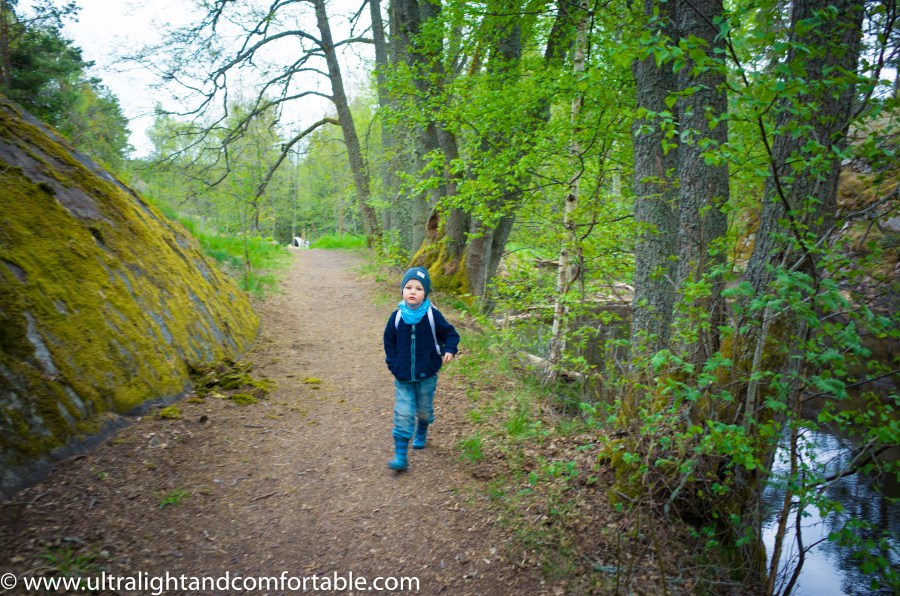

Is this big rock where the troll lives??

My two sleeping mats are a thermarest xl xTherm and an Xlite small. The xtherm is excellent for my winter adventures and the xlite is a great torso pad that weighs 200 grams for 3 season use. It’s also a perfect kids sleeping pad.


Our entire kit for the night. The duomid, two quilts, sleeping pads and more

The tent I use is the Mountain Laurel Designs duomid with no inner tent and two trekking poles setup in an apex at the top opening up the center completely. A great two man tent that weighs 700 grams with the perimeter netting.

I even bring along a tenkara fly rod and flies to do some fishing with total weighing in at 103 grams. A hammock for him to play in, a DD super light hammock that weighs 270 grams, food, and flashlights to go look for trolls with.


Depending on how where feeling we´ll even bring a MLD Trailstar.. Though it’s less accessible than the Duomid. It’s much larger floor space means no fast in and outs

Everything I need for me and him with extra clothes, food and gear fits in my HMG windrider with room leftover and weighs less that 6-7 kilos for all gear and food for an overnight trip. If we want to be out several nights we just pack more food. Simple as that. No shit gear, no wasted money, just great gear for all seasons and reasons.


Everything fits nice and snug in my HMG windrider. Well, minus my sons toys which he gets to carry in his own backpack.


R0260292


My gear list when going out with the little one:

Item Ounces Grams
Packing
Hmg Sidewinder 4400 34.2 970
Red 2l Pack Bag 0.7 21
Red 4l Pack Bag 0.9 25
Green Pack Sack 4l 1.1 30
Thermarest Pillow Sheet 1.9 54
Shelter
Ti Tent Pegs 3.5 98
Mld Duomid Complete 26.7 756
Sleep
Thermarest Pump 2.6 73
Enlightened Equipment Quilt 22.9 650
Synthetic Sleeping Bag 24.7 700
Xtherm 20.5 580
Xlite Small 7.1 200
Eye Mask 0.5 15
Cooking
Sea To Summit Long Spoon Ti 0.4 12
Ti Tri Fusion 3.2 90
Snowpeak Ti 900 W/lid 4 114
Sawyer Mini Filter 1.4 41
Zefa Water Bottle 3.5 98
Marches 0.4 11
Clothing
Mld Waterproof Gloves 1.6 46
Wp 200g Pants 6.1 174
Haglofs Green Wind Jacket 2.3 65
Haglifs Lim Puffy Jacket 6.7 191
Ula Silnylon Rain Skirt 2.8 78
Patagonia Alpine Rain Shell 6.4 181
Other
Fallkniven F1 6.9 196
Ul Teeth Care 3.1 89
Murla Knife 0.7 20
Bd Headlamp 3.6 101
Iphone 6s Plus Ink Case 9.9 282
Thermarest Repair Kit 0.5 14
First Aid Kit 3.1 89
Usb Cables 0.8 24
Tenkara Sawtooth Fly Rod 3.4 95
Worn
Consumables
Coffee 3.5 100
Toilet Papper 5.3 150
Food For A Day 26.5 750
Alcohol 5 Days 14.1 400
218.1 6183
essentialsGear reviewstrekking poles

Gear review: Fizan compact trekking poles

A few weeks ago I was contacted by a representative from Massdrop on writing a review for one of their upcoming massdrops. For those of you not familiar with massdrop it’s a community or social shopping network that sets up different products for ridiculously cheap prices. For example right now they have an 800 down Enlightened Equipment high quality quilt on sale for 189usd. So the prices are fantastic and the products on offer are often of the highest quality.

Being the kind of guy I am, I have no problems exchanging my time for products and doing a review as long as I can fit it into my schedule. Also it’s not unusual for me to get request to do reviews for products and companies in the USA as a lot of my visitors to this site come from the USA. (Not so strange considering I write in English and come from the USA myself).

With that said, I have known about Fizan as a company for some time as they make trekking poles that are known throughout Europe as a high quality brand. I’m not sure if the products exist in the USA, but in Italy and Europe they have been around since the 1950’s and still being made in Italy.

The timing for Debbie over at Massdrop couldn’t have been better as I was in the market for a new pair of trekking poles as I’m not completely happy with the ones I have. I was in the market for highly adjustable, lightweight, aluminum poles. (I keep breaking my Carbon fiber poles). Feeling I would be more than happy to sacrifice some weight for the added strength of Aluminum.

Weight:

Anyway, I got my Fizan compact trekking poles in the mail a few days ago and I was immediately surprised by the writing on the poles ”worlds lightest trekking poles 158grams”. I thought – bull… But to be honest they are the lightest adjustable poles on the market which is pretty awesome. (Correct me if I’m wrong here). My current carbon fibre adjustable poles weigh in at 184 grams each. These with the straps and baskets weigh 175grams. Take off the straps and baskets (which I normally do) and were down to 158grams each. Light.

R0260522
175 grams with the basket and strap on. Hard to find Carbon fiber adjustable poles at this weight.

Quality

As I stated I haven’t had a whole lot of time to test these out, I have been out a few nights and walked a total of about 65 kilometers with varying weight on my backpack and with two different tents. (The MLD Duomid and the MLD Trailstar). The poles have held up well (holding the tents up) even in some really heavy wind and rain on one of my nights out.

The Fizan compacts use a three part proprietary interlocking system, that they have been using for years in their compact system without problems. I find no reason to doubt this interlocking system.

To be honest, I have no real issues with the quality here, as I said before, Fizan is a well known brand and I have had their poles once upon a time a few years back, they never let me down. I don’t feel like this will be issue with these poles either.

R0260489

Looks and feel

I think these poles look good, as good as trekking poles can look that is. They are still old people sticks (joke from my book), but do what they are suppose to do. I have seen much uglier poles. They do however feel fantastic. Weight and balance and even the tiniest of attention to details really stand out. I like the feel of the straps and how small the poles pack down to due to the three part adjustable system.

The color on the Massdrop sale for these pole swill be blue and not the red that is seen in these pictures.

Size

My Fizan compacts are adjustable from 58 centimeters (23 inches) to about 132 centimeters (52 inches) maxed out. In other words perfect from any toddler sized human to about my size 190cm (6’3”).


R0260515
The Fizan sticks holding up an MLD Duomid + Innertent

Specs:

Weight with straps and basket: 178grams each

Height: 58cm (23 inches) – 132 centimenters (52 inches)

Material: 7001 Lightweight Aluminum

Locking: Proprietary Flexy internal locking system

Grips: Ergonomic EVA foam grip with rounded plastic top

3 sets of removable baskets: 35, 50, and 95 mm

Suggested price: $59.99

Massdrop start date: Monday, June 5 at 6 a.m. PST.

Address for the massdrop site and sticks:

https://www.massdrop.com/buy/massdrop-fizan-compact?utm_source=Iterable&iterableCampaignId=122529&iterableTemplateId=178324&utm_campaign=massdrop_x_fizan_compact_trekking_poles&mode=guest_open&referer=C9BLKJ&utm_medium=email


PROS:

Lightweight adjustable poles

Aluminum

Extra baskets

Cheap (to be honest, I’m surprised by the price on these.. This is cheap)

Great brand

Made in Italy


CONS:

Aluminum (You can get lighter with non-adjustable carbon fiber)

The tips on these are wider than standard trekking poles which means the pole extender on the MLD Duomid won’t work. That’s why in the picture above I use PVC piping instead of the carbon fiber pole extender.

Perhaps shouldn’t be used as ski poles…. . .


The Fizan compact poles are an excellent compliment to the MLD Trailstar as they are highly adjustable.


TO read more about these poles check out this excellent, detailed review:

https://www.massdrop.com/talk/1797/upcoming-massdrop-x-fizan-collaboration?utm_placement=3&referer=PYEQYA&mode=guest_open&utm_campaign=Automated%20Daily%20Promotional%202017-05-26&utm_source=SparkPost&utm_medium=email&utm_term=Daily%20Promotional&utm_content=1495797900732.028910651407058611965059


Running

Faster, stronger, less fatass…

My running progression is coming along good enough. I’m not completely happy with my results so far but I am in a lot better condition and position than I was at the beginning of my running career in January. Running has now become fun, which in the beginning it most definitely was not. My new found whole food plant based diet keeps me well fueled and ready to run at a drop of a hat, and my once painful 1 hour 6 minute 10 k, has now become an easy 50 minute 10k. I hope this time next year I will be able to be in the 40 minute mark.

Some problems I am having though is proper fuel for my longer runs, and considering I have a marathon in 5 days, this is something to worry about. I feel I start crashing after 15 k, and I usually have to stop 5 minutes, eat an energy bar, drink coconut water and then I can continue. Then When I get up at 20 k my body is completely depleted and I hit sometimes (not all the time) the provibial wall where my body simply can’t move. I’m guessing that I have to be better at eating at every 30 minute intervals, which is something I haven’t been very good at.

So my strategy and goal for the Stockholm marathon is to run in 4 hours 30 minutes. My strategy to do this is to run at a cool but easy pace and eat at every station regardless of my hunger or lack there of. I’m not too concerned about my endurance, just my fuel. Keeping my body well fed I think will be the key for me.

On a side note, a combination of my diet change and my running I have now lost around 20 pounds of fat and body fat down to around 21%. Still high, but I’m not trying to diet, I am making lifestyle changes that I plan to keep throughout my life time. I don’t really care about the get fit quick, though I do think that with a little more discipline around sugar and fats, that I should be able to move my progress considerably faster. I don’t really have any goal in site, just to be at optimal running weight which I believe is about 77 kilos for me and 12% body fat. This should lower the pressure on my back, shoulders and knees. Right now I am somewhere between 86-88 kilos depending on the day…

My plans for after the Stockholm marathon include a couple of half marathons and if I’m feeling courageous perhaps another marathon before the year is done. As I’ve said before, I am literally starting from scratch so my goals are more for building a base and a love for running, than going all out and risking burning myself out. But as with all things I need to compete inorder to stay interested, I need the competition in order to get myself out the door everyday. At-least this is how I feel right now.


GearPhoto reviewsPhotography

My favorite backpacking cameras

Through the years I have used many cameras on the trail, and several of them I have written reviews on. I thought for fun I would include a few pictures and a few of my favorites here. I know what your thinking, it’s not the gear that makes the photographer, and it’s absolutely correct, but it sure does help to have quality gear that inspires. You will notice I don’t put any importance on year the camera was made, I do this because I don’t really care. I love the Sony rx100, is it as good as the rx100 m4? probably not, but I wouldn’t know as I haven’t owned the m4. I have owned the m3 and I thought it too was an excellent backpacking camera. Anyway, here are my personal favorites:


Fujifilm X-T1

OLYMPUS DIGITAL CAMERA

It’s hard not to love this camera. It takes amazing pictures, the XF lenses are the best lenses on the market, and to top it off because of the release of the X-T2, the X-T1’s are relatively cheap now. The fujifilm with the 18-55 kit lens is a fantastic backpacking combination that weighs around 800 grams total.  16mp sensor.


Fujifilm X100s

$_32

Super crisp pictures and a set focal length of 35mm. What’s not to like. Missing the classic chrome film simulation mode and not really the best for video. However, an excellent backpacking camera. weighs 430 grams and 16mp sensor.


Sony RX100

121031_sonycybershot_003-660x440

Small, light and excellent sensor. I used the sony RX 100 on my solo trip in Iceland and don’t regret a thing. Perhaps not the best quality when compared to Fuji, but still an excellent all around compact camera. 245 grams and 28-100mm lens and 20mp sensor. These can now be purchased relatively cheap on the classifieds.


Sony RX100 m3

Z-SONY-RX100M3-FL-EVF-FLASH-L

Everything I love about the sony RX100 the M3 does better. The lens is criper, the files are cleaner, the sensor is better and the Sony RX 100 M3 even has a built in viewfinder and HD video. Only negative? 24-70mm lens is perhaps less flexible than the 28-100 on the Rx 100.


Ricoh GR

ZYFRONT-LG

Small, light, excellent pictures and sensor… what’s not to like? Some people don’t like single focal length cameras, personally they are my favorite. I hate having to think about what lens might work best for a certain situation. Why bother? The 28mm lens on the Ricoh GR is one of the best on the market. Excellent for both backpacking and street photography. The Ricoh GR weighs 245 grams with battery and has a 16mp sensor.


Fujifilm X-T2

IMG_7566-acr

The Fufilm X-T2 is no simple upgrade. It’s basically a completely new camera as compared to the X-T2. Sensor upgrade to a new Xtrans 24megapixel, two memory cards, autobracket for HDR and 4K video to name just a few of the upgrades. The downside of course being that a X-T2 will cost you twice as much as the X-T1 at the moment. But like all the Fujifilm cameras, the X-T2 is probably the best mirrorless camera on the market and easily competes with most full frames. The weight is similar to the X-T1 at 450 grams with battery.


Runner up:
Sony A7R

Small body, clunky lenses and massive files that takes days to transfer to computer.. Excellent picture quality but a bore to use. Some of my best pictures have been taken with the A7R, but I can’t recommend the camera as for every one excellent picture 10 are bad. Why? because the shutter causes vibrations in the photo making sharp pictures handheld very difficult.

GearGear reviewsUncategorized

Gear review: Hilleberg Enan

A few years back my first gear review I ever did on this site was a review of the Hilleberg Akto. I liked the tent but found it had too many faults to really consider it a keeper. I even wrote in that review that if Hilleberg were to fix the sagging innertent and lighten the tent to around 800grams that I would be more than happy to purchase the upgrade. A few years later and as I so humbly like to take credit for (though they probably have no clue who I am.. still), Hilleberg did upgrade their Akto with the Enan. While not 800grams, it is 1100grams complete in stuff sack with pegs. They did fix the sagging innertent and as an extra bonus even gave it a lot more ventilation allowing for better  air circulation and much less condensation.

DSCF4387
The Hilleberg Enan has a small footprint, allowing setup in tight areas

I will start by saying that I love the Enan, I think it is an excellent tent, fun to use, fast and easy to setup that even a monkey could make it work. The enan is by far the easiest tent I have ever had the pleasure of setting up, even beating out the Mountain laurel designs Duomid in simplicity. A small tent pole and theoretically two pegs and your done. It really is that easy.

You might think that being a lighter tent, the Hilleberg Enan loses out on space, or “ruggedness” compared to the Akto. I beg to differ, this tent is made for the mountains, and all the weather than entails. I can gladly say that even in the heaviest of winds, worst of downpours and even light snow the Enan has held up really well.

DSCF4251
Two large vents on eachside of the Enan allow for great air circulation


What is it:

The Hilleberg Enan is a single man, tunnel, coffin style, double walled tent and Hillebergs lightest tent in their line-up. People like to describe these tents as bomber, but honestly I hate the term, so I will stick with rugged, mountain tent for 3 season use. Though, for many people, the Enan would work just as well as a 4 season tent.

Weight:

The Hilleberg enan 2016 variation that I have weighs 1200grams complete with all guylines, tent pegs and stuff sack. The 2016 variation uses Kerlon fabric 1000 which is a little heavier than the 2015 variation that uses Kerlon 600. Not the lightest single man tent on the market, but definitely not the heaviest either

Size:

Where the Akto lost me in a sagging innertent, weight and bad ventilation along with being a tight fit. The Enan fixes atleast most of these issues and because of no sagging innertent, the Enan even seems roomier. While I love the Enan experience, I don’t really want to be stuck in it for longer than just an overnight sleep. I find the coffin style one man tent to be just a little tight for my liking.

screen_shot_2015-05-01_at_3.59.41_pm

One tent to rule them all?

I think for most casual backpackers looking for just a single tent that they can have for 30 years in any weather conditions, the Hilleberg Enan, much like a lot of Hilleberg tents, is just that tent. It’s light enough for most backpackers, and robust enough to last a lifetime. On top of that it is extremely fast and easy to use. For taller people like myself at 6’3″ (190cm) I would suggest looking elsewhere as it may be a little to tight a fit for the long haul. If you are looking for an ultralight tent, then I would also suggest looking elsewhere as the enan is on the heavy side when compared to many competing tarp-tents. Though to be fair, most backpackers carry more than just a tarp, they usually have trekking poles (250grams minimum, inner-tent of some kind, 250 gram minimum, ground floor… so on and so forth)

However where Enan wins, and Hilleberg in general, is in quality. Your not going to find a better made tent anywhere. The attention to detail, the fabrics, the quality of the sew, there’s nothing quite like a Hilleberg, which is why I’m always willing to give Hilleberg a chance. There’s nothing quite like the look and feel of a Hilleberg and the Enan is no exception.

DSCF4328
The Hilleberg Enan really is simplistic perfection. An excellent one man tent


Conclusion:

As I stated in the beginning, I love the Hilleberg Enan. Maybe it’s the quality of the product, the ease of use, or perhaps it’s just the brand Hilleberg. Whatever it is it’s hard for me to part with this tent. If your somebody who wants a simple to setup, one solution for all conditions and don’t use trekking poles, then the Enan is hard to beat. However for me the Hilleberg Enan is a tent that is too small for my use. But it’s just so damn good.


Pros:

  • Lightweight single man tent
  • Fast and easy to setup and use
  • Excellent build quality
  • Hilleberg
  • Great ventilation = lower condensation


Cons:

  • Expensive when compare to most chinese manufactured competitors
  • Heavy for the size and living area


You can buy the Enan in Sweden at: https://backpackinglight.se/varumarken/hilleberg/

or Europe: https://backpackinglight.dk/brands/hilleberg


GearGear reviews

Gear review: Jetboil TI Sol

I have owned the Jetboil TI Sol for almost 3 years now, so this has to be the slowest gear review in the history of gear blogging. I’m not sure if I can add anything to discussion, but what the heck. The Jetboil TI Sol is the titanium version of the Jetboil solo stove. A complete cooking system in a light package. It’s main purpose is to boil water, and it’s damn good at boiling water.

If  your like me and just about any other backpacker on the planet, your main need is to boil water to rehydrate your packaged foods and boil for coffee.. then the Jetboil should suite your needs just fine.

What you get

The Jetboil TI Sol is a self contained unit with everything thats needed in a simple little package. It has a pezo lighter built in, an adjustable pressure regulator, insulated pot sleeve, Plastic lid with strainer, a plastic cup and last but not least the actual pot itself that is .8 liters.

DSCF4435

A gas canister easily fits in the pot along with with the regulator. I usually leave everything at home except for the pot, lid and gas regulator. Though I’m certain that the rest of equipment serves a purpose….

DSCF4429


In use

I am a sucker for simplicity and I’m not sure it’s possible to make an more simplistic stove. Just screw on the gas can, put the pot on and press the ignitor. (this of course can be said for any jetboil or these style of stoves). Having used this stove on and off for over three years it has only failed me once, in Iceland, pouring rain the ignitor didn’t take. With that one exception this stove has been very trustworthy. There is a lot to be said about these kinds of stoves and there is a very good reason they have become so popular during the last decade or so.

With that said the Jetboil TI Sol has one function and one function only: Boil water as quickly and effeciently as possible. There is no simmer (officially there is, but don’t bother). This one function it has and serves perfectly. Boil time on my kitchen stove (which by the way is the most useless metric in backpacking is a staggering 3 minutes and 47 seconds with .5 liters of water) Fuel consumption is around 5grams of fuel. In the wild depending on the wind and chill factor (colder air means slower boil time), boiling is around 3.5 – 5 minutes. I usually try to calculate for my trips 8 grams of fuel per boil.

However this gives kind of an unrealistic picture of the jetboil and how I use it. I rarely boil water in the wild and most the time I run water through my filter and get the water to “warm enough” – which is around 2.5 minutes and 4 grams of fuel. Meaning one tiny can at 229 grams will last me a very long time along a trail.

DSCF9303

Eating

This probably goes without saying but I will write anyway. I eat directly from the pot, because the pot is rather tall I find that regular length spoons are a pain, so I use a long length spoon to dig deep in the pot. Also, though the cozy I’m sure serves a purpose, it atleast let’s holding a freshly heated meal possible.


Conclusion

A lot of new stove system have been introduced on the market since the Jetboil TI SOl has been released. The weight differences today are perhaps not as wide as they once were. Aluminum systems that weigh 100 grams more can be bought for a 100usd less. There are also simple pot and stove solutions that weigh 150 grams total (evernew pot and BSR 1000 titanium stove). However, I still find the Jetboil ti sol to be a viable solution if your looking for this style stove. They can now be purchased at competitive prices on ebay and amazon. This system is still to my knowledge the lightest fast boil system available (correct me if I’m wrong)

After three years this system is still going strong for me and while it might not be my first choice, it is by far my simplist choice.


The good:

Complete cooking system

Fast boil

Self contained unit that fits nicely in my backpack

Relatively light at 242 grams for the trimmed down system that I bring (just the pot, lid and regulator)


The bad:

Like hot water? That’s all your going to get with this. Don’t bother bringing anything else

Not sure what purpose the pot cozy has.

Heavy compared to some of the ultralight kits available. (Trail designs, BSR1000, any alcohol stove and so on)

Uses gas – I am terrible at determining how much gas I need to have with me, thus I always bring way too much.

No wind shield.. Always looking for a hole to dig this down in as each breeze increases boil time significantly.

mindfulnessRunningUncategorized

When doubt takes over

Yesterday I ran 26 kilometers during a competition called the Lidingö Ultra. It was both a 26 and 50k competition. I was complete garbage during this race. 26km for the most part is not a problem for me, but 26km on a course that likened a roller coaster I found to be too much. for the first 16km life was good, I was truly enjoying the run and having a great time. Then somewhere along the line doubt started to creep in, maybe it was the burning in my thighs, or the pain in my back, or my empty stomach screaming louder than normal. In any case, the doubt crept in and the more doubt I had the bigger the challenge became.

This particular course has 20 steep inclines and deep declines to match along the 26k course. I don’t normally run these kinds of courses but I thought it would be a great challenge. It was definetly a challenge, and I times I just wanted to throw in the towel. In any case I crept along the finish line and can say I did it. Though along the way I started doubting me ever becoming a real runner, you know, the runner that runs 50k on this kind of trail in 3 hours? which by the way was the winners time.. 3hours 16 minutes on a 50k roller coaster. Insane!

When I got home I crashed on my sofa and just watched football and ate anything my body could take in.. I was spent. No matter how much I ate I was still hungry.. Crazy day. With that said, today I am looking forward to my first marathon in june. Yesterday I was hating the idea and was thinking about dropping out, not anymore. Today I feel good mentally and physically.

Once I was done with the race I started thinking about all the times I let self doubt get in my way. When I let self doubt become my provibial brakes to achieveing my goals. This was certainly not the first time I had self doubt, and won’t be the last. This just happened to be in my mind the biggest physical challenge I have ever had to overcome. We all have self doubt, it’s a perfectly natural occurance, it’s when we let the self doubt become the main voice in our heads, that’s when we fail. Yesterday I was feeling good, my body was feeling fantastic, until I let my mind take control of the situation.

Today when searching articles about self doubt I ran across Zen habits recent post on just this specific feeling.

“We doubt ourselves, feel inadequate, dislike our looks, criticize our failing harshly, feel uncertain about whether we’re worthy of praise or love.

The result is anxiety, procrastination, fear, and the inability to change our habits. I’ve seen so many people who are unable to stick to an exercise program or healthy diet changes because they don’t believe in themselves. At the heart of their failure to make positive changes is a deep feeling of unworthiness and inadequacy.

Every time we fail, we are harsh with ourselves, and we see it as just more evidence that we suck. Every time things are less-than-ideal, we blame ourselves (or, if we don’t want to be blamed, we blame other people).

What if, instead of beating ourselves up (or blaming others), we just accepted what happened and then took appropriate action? What if we took this as an opportunity to see our humanness, to love ourselves, to see ourselves as innately good?”

When backpacking and self doubt starts to creep in I can just focus on what an amazing experience being in the outdoors is. When the weather turns to shit I can just say the old swedish mantra to myself “no such thing as bad weather, only bad clothing”. When writing, I am convinced that my writing is terrible, even this stops me from writing sometimes. But to get over that feeling I just start writing and eventually I find a flow in what I’m doing and everything else disappears.

With running though? Obviously I have some work to do… But my strategy going forward will be as follows:

  1. Medidate pre-run to clear my mind and relax my anxieties.
  2. Train better – I had been training for a relatively flat marathon the last couple of months. I don’t see and hill training will hurt my marathon running so I will start adding some hill work in my runs.
  3. When doubt starts to creep in mid-run find somthing other than pain to focus on. Yesterday I got so focused on how much my legs hurt from the roller coaster run that I couldn’t find any joy in the run itself.
  4. My focus point when all else fells should or could be a mantra of some kind. Scott Jureks mantra is “sometimes we just do things”… simple and fun.


GearGear listGoing LighterUncategorized

Starting your backpacking life

I have a friend who is starting to get interested in backpacking, we went on a short trip last year and had a great time despite the fact that we melted each-others shoes and almost burned down our hut. Anyway, to say his backpacking skills were limited is an understatement, and his gear was pretty bad as well. All things considered it wasn’t really his thing. But the experience kept with him and he’s starting to book different trips for backpacking and so on. With that he also wants suggestions on gear – this is when I realize that I’m better at writing generalizations than actual gear suggestions based on user experience.

So I’m having to really think about this a bit as I want him to have good gear that will last a while, be easy to use, comfortable and light. I want him to avoid the regular failings of every newcomer to the backpacking experience. The one that starts with the visit to the local gear shop, asking the salespeople what gear to buy and leaving with no money and a shit load of useless gear that will be phased out with experience.

To start I have to look at my local market: What is possible for him to buy in our area. Being we are in Sweden it’s not the easiest to buy “ultralight gear” without it costing and arm and leg (with import fees and shipping). Also, one of the pleasures of shopping is seeing, feeling and experiencing. So in this sense the local gear shop is an excellent place to start for a newbie. It’s not just a question of staring at a picture and making a purchasing choice.

I wrote in an earlier article that I didn’t think that “Ultralight” might be the best choice for every backpacker, and I still hold that to be true. I think staying true to the ultralight idea requires a steady knowledge of a specific climate. (why ultralight tends to work very well along major trails like the Appalachian and PCT but much less so in brooks range alaska and Northern Sweden, where temperatures and weather can be highly unpredictable). With that said I do think that striving after minimal weight should be the focus for just about anybody. Why buy a backpack that holds 70 liters and weighs 3 kilos when you can purchase a backpack that can hold 70 liters and weighs just 900grams. The former is just a stupid choice regardless of where one might hike.

The same can be said for a tent, sleeping bag and sleeping matt as well. Ultralight in the regard of sleeping under a cuben tarp and no ground floor is perfectly acceptable in warmer more predictable climates and trails. 300 grams and your done. Or you can choose a two man Hilleberg beast that weighs 3kilos. While the Hilleberg might be perfect for two people during a winter trip, it serves no real purpose in the summer months. However something like a Mountain laurel designs Trailstar with an inner tent might be the best of all worlds. Total weighing under 1 kilo, large enough for two people and can withstand just about any weather that is thrown it’s way.

DSCF4248-2
The Hilleberg enan is a fun, fast tent big enough for most users. Expensive but will definately hold for the long run.


dsc07830
The MLD duomid is a large tent that weighs around 600 grams. With an innertent duomid becomes the ultimate 1kilo dubble wall tent.

This kind of reasoning should be applied to gear purchases. I know it’s an awesome experience walking into  a gear shop and buying all the coolest gadgets, and perhaps you should buy them so that you can get a better understanding of what you actually need. But, if your more like my friend, who will probably make the initial investments but never keep the same kind of interest that I have, than buying the right gear from the very beginning will help you and (him) keep the interest longer by making those first crucial hikes an enjoyable experience.

In this exercise I will put up several gear solutions in table form and total weight. One is the traditional solution, the middle column is for “lightweight in gear shops” solution and the third is the optimal lightweight solution for any newbie that won’t cost significant sums of money. You can start splurging on cuben fibre gear once the interest has become big enough to justify that kind of investment.


Gear choices:
Traditional weight grams lbs. Lightweight gearshop weight kilo lbs. Cheap(ish) preffered lightweight weight grams lbs.
Backpack Backpack Backpack
Fjällräven Kajka 75liter 3.6 7.92 Granite gear V.C 0.98 2.156 HMG Sidewinder 4400 70liter 0.980 2.156
tent tent tent
Hilleberg Nallo 3 6.6 Hileberg Enan 1.2 2.64 MLD Trailstar + inner 0.98 2.156
sleeping bag sleeping bag sleeping bag
Fjällräven Sarek 3 season 1.3 2.86 Mountain hardware hyperlamina spark 0.65 1.43 Mountain hardware hyperlamina spark 0.65 1.43
Sleeping mat Sleeping mat Sleeping mat
Exped down 9 1.2 2.64 Thermarest xlite regular 0.38 0.836 Small Thermarest xLite 0.23 0.506
Total big three: 9.1 20.02 3.21 7.062 2.840 6.248


It is possible to get a lighter tent and even cheaper tent than the Hilleberg Enan in a gear shop. I just put in the Enan because out of gearshop tents available the Enan is my preferred tent. Expensive but great. However the Mountain laurel designs Duomid or Trailstar with an inner-tent is atleast in my own reasoning the best all around solution for comfort, weight and durability. This I have as my choices in the “prefered gear list” column. The difference between gearshop and prefered is the fact that prefered will probably have to be special ordered directly from the producers websites while the gearhop is usually gear easily found in most gearshops.

Also, there are certainly lighter and warmer sleeping bags than the Hyperlamina spark, but for a good three-season lightweight sleeping bag that is cheap, the hyperlamina is hard to beat.

All these gear choices are chosen for the solo adventurer in three season hiking in all-around temeratures and climates. Meaning that this solution will work just as well on the pacific coast trail as it would in northern sweden.

A good rule of thumb when purchasing gear for the first time is the 3 for 3 concept. The three biggest pieces of gear: tent, sleep system and backpack for a total under 3 kilos. The lightweight gear shop solution crosses the threshold by 200 grams, but I think that’s ok all things considered.


minimalismminimalistsimplicity

Phase 2: The minimalist experiment

Almost a year later from when I started my minimalist journey and I find myself gravitating to a more zen like discipline in my daily life. I want everything to be simple and useful. Rather one thing that fills the function of many or nothing at all. Or finding contentment in just being. In my phasing out of stuff I am now at a cross roads where the stuff I have left is stuff I couldn’t get rid of the first few times around.

Books I have been absolutely convinced that I would read, or cook books that I knew that I just had to have. Camera gear and a bicycle that I find I am having a hard time parting ways with. The camera gear fits within my goals, hobbies and interests, the bike on the other hand? It’s fun to take out every once in a while. But at the moment and within the foreseeable future I don’t see myself partaking in any competition or meaningful activity that would suggest or motivate me keeping my bike. (This particular bike).

My goals right now consist of running an ultra marathon in May, the Stockholm marathon in June, backpacking and photography in northern Sweden, finish two books I’m working on plus a video course and moving to Zambia within the next year for at least 6 months to a year. None of these activities requires my particular bike or if anything the bike I have creates a stress of having to use it… And considering my daily quota of hours that I can allocate to riding a bike are minimal for the foreseeable future (I mainly need to run), I am having a hard time making a case to keep the bike and other such items.

It’s these kinds of choices that I now find myself having to make. Getting rid of books that made it through the first phase, since becoming vegan almost all my recipes are on apps (So I am giving away all my cook books to friends and family). I find that the choices though are getting easier, not just for myself but as a family unit things are getting easier. It’s the Zambia trip that is making us really give everything an extra thought. Because in all honesty when we leave Sweden, the only stuff I want left is the stuff I bring with me. I don’t want to own anything that is left behind. The exception being the house which we will rent out and a few personal items that belong in the house (TV, Couch..)

With that said, I find some of the stupidest things I have an attachment to.. A memory attachment, or something that’s serves no other purpose than the idea that at sometime in the future I may or may not use this item (Welding machine). I have old suits that I never use, excellent quality suits, and a throw back to a past life.. Still an attachment with no purpose.

I feel as if through this phase, the phase of getting rid of stuff that made it through all the other phases is really a demanding feat. It truly requires that I think deeply, ponder the usefulness, the meaning and the value that each item brings me. There is not a lot that brings this kind of value to my life.

Here is my strategy so far:

  1. Place all the stuff I believe I don’t need or want in boxes and store the boxes in a closet. Whatever is left in these boxes after 6 months goes.
  2. Write up a list of my goals for the next year. What purchases or items that I already own do I need to accomplish my goals? Are the things left outside the focus of my goals a distraction from my goals? If so, they go.
  3. By practicing my Leave no trace at home, I am finding that I give all my items and stuff a second look. Just the process of picking up after myself is creating an awareness of my stuff.
  4. Making conscious choices about what I bring into my life. This is done by constantly referring back to my goals and ambitions. With this purchase help me in my pursuit? I recently listened to a podcast on the Rich Rolls podcast channel where Rich had a discussion with Leo Babauta from Zenhabits.com. An amazing episode that really is required listening. Leo talks about, among other things, this very concept.
minimalismsimplicity

Leave no trace – The living experiment

I have been thinking about something a lot lately. The idea for me started when I got a comment on my book “ultralight and comfortable” about the chapter on Leave no trace. Now this introduction and the actual article that follows have very little to do with each other, but just the idea about being in the outdoors, the simpleness of it all, and in some ways the full experience of being in the “now” as it were. There is another aspect within backpacking called the leave no trace. It’s the idea of when you are in the outdoors you leave as little trace as possible behind you when you go. For example, bring your trash with you, bury your poop, don’t chop down perfectly healthy living trees and so on. So I started to think about this and it’s implication in everyday life.

If there is one thing that drives my wife and myself crazy it’s how messy the house gets from one day to the next. As if some kind of magical dirt elf ran around spreading shit all throughout the house just to irritate the piss out of us. It’s not unusual for the elf to leave my pants in the living room (it’s my thing to take off my pants as soon as I get home), or how the elf leaves out my wife’s arts and crafts on the kitchen table. Hell the elf even has a habit of leaving out dirty dishes, iPads, phones and socks. Even little things like remote controls and books get spread out throughout the house. Then comes cleaning day and my wife and I are always and equally surprised by how bad everything got over the course of the week.

Too be honest the two discussions that we have the most right now concerning cleaning and all around happiness is this:

1. My wife wants to hire a maid to clean up after the elf
2. I want to clean out everything we own so we don’t have anything for the elf to spread

However a third option has started to brew in my mind: Leave no trace. How hard can it be to put things back from where they were taken? Or does everything actually have to be moved from one spot to another? Let’s me be honest here, even if I got my way and cleaned out the house completely, I would still have my pants on the stairway, my iPhone on the sofa table, the tv controllers will be placed anywhere from under the sofa to behind the kitchen table.

Now practice leave no trace with minimalism and I seriously doubt a maid will be needed. I think leave no trace creates a kind of discipline sourly lacking in our lives (my family).

So here is my challenge for the next few months to see what happens, as with all new habits, in-order to form a new habit and old one must be broken, slowly but surely:

  1. Create a new habit of picking up after myself.
  2. I will start small – First my bed every morning (been so long ago since I last made my bed, I almost forgot how to do this)
  3. Putting my computer back in it’s spot, iPhone and tv remotes
  4. A book I take out I will put back
  5. Clean up after myself after every meal (I usually cook dinner)

My guess is that by creating these small changes everyday I am training myself to be more conscious of what I do during the course of a day.

  1. I won’t be leaving a large mess to clean up later.
  2. I love emptiness or tidiness, I love cleanliness and it makes me happy.
  3. I won’t have as much clutter.
  4. I will be more aware of my surroundings and my daily life.

Sometimes that is all that is needed in-order to be happy: To just slow down and realize what you do and have.