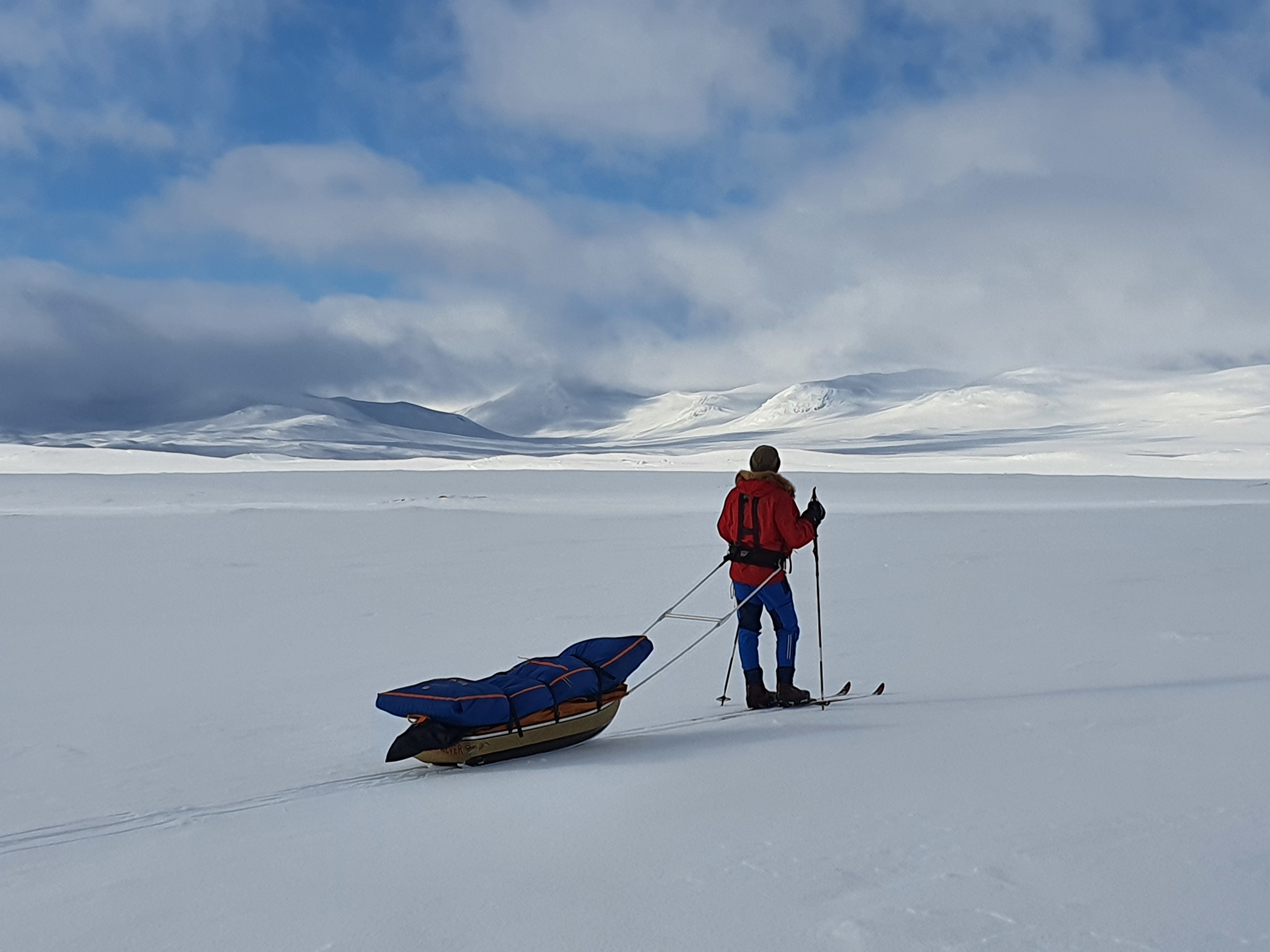
Breaking Boundaries: Ginas Quest for the South Pole Speed Record


Today, we’re thrilled to introduce you to Gina Johansen, a remarkable Swedish explorer embarking on a journey that pushes the boundaries of human endurance. Join us as we delve into Gina’s extraordinary quest for the South Pole speed record.
Gina’s journey is a testament to the indomitable spirit of adventure that drives us all. From her humble beginnings in the world of horseback riding to her daring expeditions across frozen landscapes, Gina’s story is one of resilience, determination, and unwavering passion for exploration.
Now, Gina sets her sights on the ultimate challenge: skiing 1130 km alone across the icy expanse of Antarctica to claim the female speed record. Facing treacherous conditions, biting winds, and unforgiving terrain, Gina’s preparation and courage shine through as she prepares to tackle this monumental feat. Additionally, Gina reached out to us at Backpackinglight seeking support to make her expedition even lighter and faster.
Join us as we follow Gina’s journey every step of the way, from her meticulous preparation to the exhilarating moments on the ice. Together, let’s champion the spirit of exploration and celebrate the extraordinary achievements of adventurers like Gina Johansen.

“My goal is to ski under 31 days to set the new women’s speed record”
Tell us about yourself, who are you?
-I’m Gina, a 32-year-old Swedish adrenaline junkie with a lifelong passion for pushing boundaries. My journey began amidst the thundering hooves of horses, but it was at 19 when I traded the stables for the sunny shores of Sydney, immersing myself in the world of thoroughbred horse racing. Over eight exhilarating years, my love for the outdoors blossomed, leading me to discover the thrill of trail running and embark on a 2700 km cycling odyssey along Australia’s rugged east coast.
In 2018, I embarked on an adventure that would forever alter the course of my life. Skiing solo from Nordkapp to Jäckvik in Sweden, a grueling journey spanning 60 days and roughly 1000 km, I found myself thrust into a world of icy challenges and breathtaking vistas. Before that fateful expedition, I had never strapped on a pair of skis, slept in a winter tent, or ventured north of Stockholm. Since then, I’ve traded the bustling streets of Sydney for the tranquility of Honningsvåg, Finnmark, a quaint village nestled just 30 km south of Nordkapp.
From traversing the length of Norway to braving the frigid waters of Lake Baikal alone in the heart of winter, covering 700 km in a bone-chilling 15 days, my thirst for adventure knows no bounds.

You have a challenge ahead of you, tell us about it?
Fast forward to today, and I find myself on the precipice of my most audacious adventure yet: a solo and unsupported expedition to the South Pole. My mission? To reclaim the female speed record by traversing the icy expanse of Antarctica, a daunting 1130 km journey across the planet’s most inhospitable continent.
Facing uphill battles every step of the way, the South Pole sits at a dizzying altitude of 2835 meters, with temperatures plummeting to a bone-chilling -35°C, and winds whipping up to a staggering -70°C. With a daily caloric intake ranging between 4500 to 6100 calories, I’ll burn through an astonishing 7000 to 10,000 calories each day. Antarctica offers little respite for the weary traveler – it’s a stark white desert devoid of landmarks, where the only guide is the compass needle and the only scenery a vast expanse of snow and sky.
So, what drives me to undertake such an extraordinary challenge? It’s the thrill of testing my limits, the satisfaction of pushing past what’s considered impossible. I want to inspire others to chase their dreams, to step outside the confines of the ordinary and embrace the unknown.

How are you preparing?
Preparation is key. Alongside rigorous training regimens encompassing strength training, endurance sessions on the skierg, skiing, and trail running, I’ve devoted countless hours to securing partnerships to finance the expedition. With the journey to Antarctica alone costing approximately US $85,000, every detail must be meticulously planned. From obtaining permits for a solo expedition to Antarctica to ensuring I have the requisite experience, the road to the South Pole is paved with challenges, but I’m ready to tackle them head-on.

Would you like to share details about your equipment, packing lists, etc.? Any items you consider particularly important?
With a speed record in my sights, every gram counts. While a typical sled load weighs around 100 kg, my goal is to pare it down to a lean 60 kg, including provisions for the entire journey. Opting for Nnn bindings over traditional BC to save weight, my gear lineup includes shell clothing, a face mask for protection against the biting cold, a satellite phone, and an inreach for communication with the outside world. Every piece of equipment is carefully selected for its lightweight design and durability, with products from Nitecore leading the charge.
Given Antarctica’s arid conditions, down insulation is a must for its lightweight warmth, while a power bank and solar panel provide a lifeline of energy under the midnight sun, ensuring I stay powered up throughout the expedition.

To sustain her power needs, Gina relies on a Nitecore Summit 20000, one of the market’s lightest power banks with a built-in heating system that ensures the battery continues to deliver power even in extreme cold temperatures.


-And that’s just a glimpse into the world of preparation and anticipation as I gear up for the journey of a lifetime.
Some tips you want to give to our readers on how to handle the cold if it’s really chilly?
Sure- here are some tips on how to handle the cold: Avoid sweating by ensuring proper ventilation and adapting accordingly. One can quickly become overheated, especially when pulling a sled. Wearing netting against the body to wick moisture away from the skin is also a very helpful tip. In the tent, having a Nalgene bottle with hot water is very useful to have in the sleeping bag to warm up a bit or to warm hands while cooking. However, it’s important to be mindful not to let water leak into the sleeping bag. Remember that clothes should not be too tight-fitting, and the same goes for ski boots. If they’re too tight, it will be cold, so you often need to go up one or two sizes, the same applies to outerwear.
We’re thrilled that Gina reached out to us, and we’re excited to see her bring the record home to Sweden. We’ll continue to keep you updated on her adventures.
Feel free to support the expedition via WOMEN SPEED RECORD TO THE SOUTH POLE – SPONSOR.ME or Sponsor a kilometer | Gina Johansen . All support is invaluable.
You can follow Gina on social media, where she shares her adventures and preparations:
- Website: https://www.ginajohansen.com/
- Instagram: https://www.instagram.com/ginajohansen91/
- Facebook: https://www.facebook.com/ginajohansen91/